

Staying Embodied During & Beyond Times of Political Upheaval
October 30, 2025.
___
“The kind of change we are after is cellular as well as institutional, is personal and intimate, is collective as well as cultural.” - Prentis Hemphill
As my current home of Chicago faces state-sanctioned terrorism head on, I find comfort in surrounding myself with people finding creative ways for us to keep each other safe. The deep ache in my heart over the span of this year eases ever so slightly with each rub of the balm of solidarity - neighbors creating mutual aid groups and daily response teams; strangers educating each other; healers offering their spaces to comfort, embrace, and feed. Some of us know each other. Many of us don’t. But we are here, showing up. Trying to keep each other as alive and whole as possible.
Since my career shift into evaluation about 5 years ago, I’ve found myself increasingly preoccupied with the ways in which care surfaces (and doesn’t) across our contractual engagements and within the field itself. As evaluation slowly matures, our field largely advocates for shifting material conditions more equitably, and rightfully so. However, less attention has been given to the deeper aspects of social change - the personal work we each have to undergo for full cultural transformation to take hold. I created the Heart, Hands & Head (3H) Approach to complement some of the powerful and beautiful evaluation frameworks that currently exist. It can be used as a personal or collaborative reflection tool to help practitioners stay accountable and more deeply embodied throughout the process. Because there are a myriad of ways to enter and engage evaluative work, there are no chronological steps to this iterative approach. My hope is that its versatility can help foster a more intentional evaluation praxis. How could a deep relational ethic and liberation from ego truly transform our field?
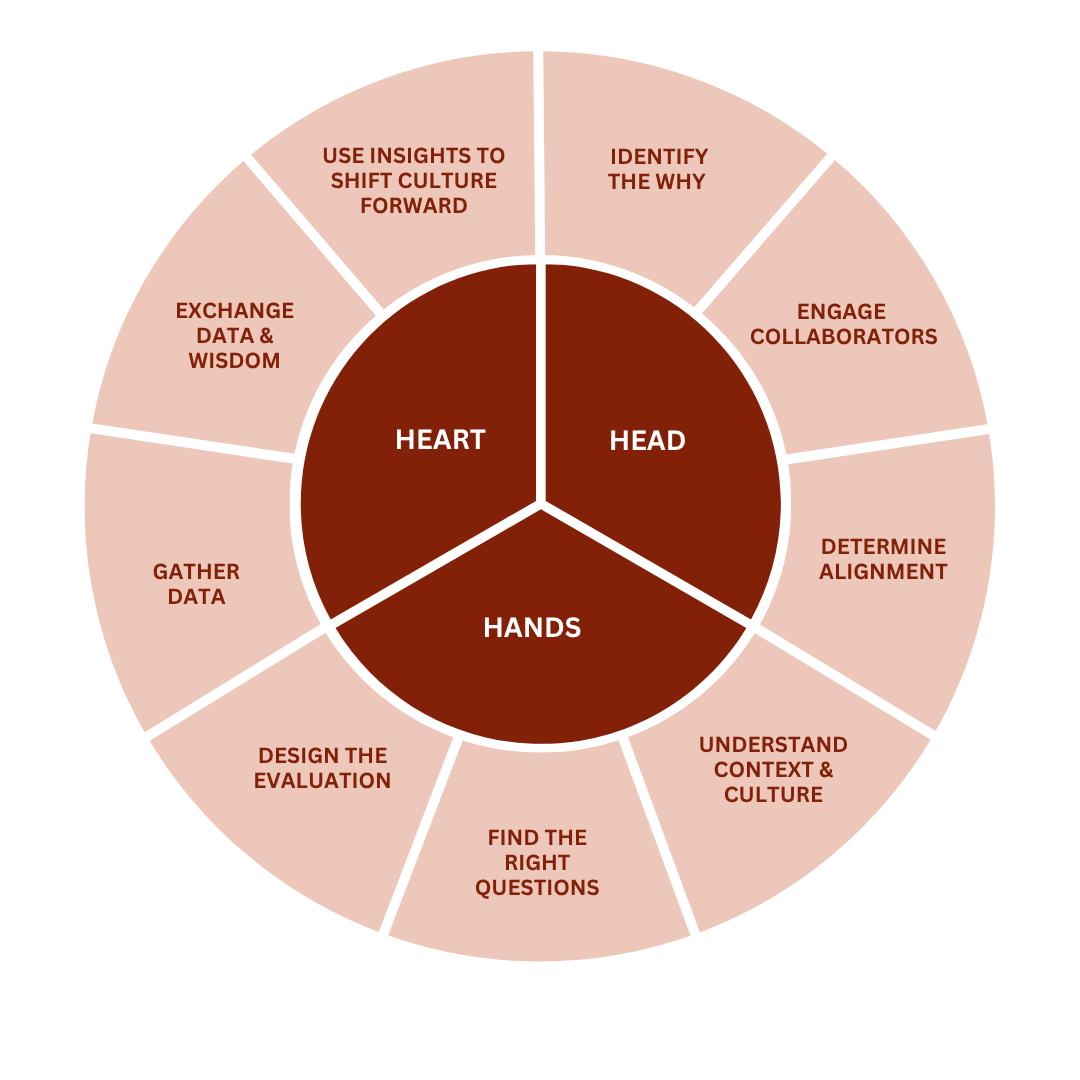
Here are a few ways evaluators can use this framework in this moment:
🫀Heart (emotions, values, connection)
What we are witnessing (and for some, experiencing) is vile. Acknowledge your humanity and the humanity of others by holding space with colleagues, partners and/or program beneficiaries to feel the full range and depth of your emotions. Every time we compartmentalize and refuse to share and bear witness to the fear, anger, and grief, we allow those who control these systems to keep us dissociated and disembodied.
Learn to tell on yourself. Imagine living in a world where vulnerability isn’t viewed as a liability but an invitation to make amends. Our LinkedIn feeds, reports and conferences would be filled with “Here’s Where We Messed Up” and “How We’ll Do Better” confessions. Hiding behind the facade of expertism and perfectionism impedes personal growth and sector learning. Being real builds a culture and practice of authenticity.
🫱🏾🫲🏼 Hands (action, offerings, supportive practive)
Interrogate your tech. Many mainstream communications and data management tools we use are nonconsensually and heavily surveilling the communities we belong to and serve. The proliferation of data centers is also creating a detrimental strain on our natural resources. Our field’s willingness to adopt AI tools we currently understand little about shouldn't come at the risk of disproportionately jeopardizing our health and the lands that sustain us. Who owns the tech? What are their privacy policies and how transparent are they about them? Creating a plan to move towards more ethical technologies, strengthening our data security protocols, having conversations about data ownership, and allocating funding for this shift is an act of societal care and trust building.
Whenever possible, consider incorporating scenario planning into evaluation processes. Those who have long felt the brunt of these systems have warned us of this moment. How can we advance the goals of an evaluation while factoring in ideal- and worst-case conditions? Preemptively co-create alternative evaluation designs in the event that pivots need to happen due to rescinded funding, retaliation, anticipated overwhelm of social safety net services, etc. Discuss how partners and communities can tap into their diverse wealth of resources and relationships. How might new strategies and undernurtured collaborations within their ecosystem sustain their work? If you work with philanthropy and groups with significant wealth, remind them of their social duty by showing them ways they can use their wealth, network and resource privileges to shield and protect vulnerable organizations. These are the moments that require our collective ingenuity.
🧠 Head (knowledge, intellect, critical thinking)
Decide how you want to show up as an evaluator. Which role(s) come naturally to you? How might these roles shift and strengthen your evaluation practice? How can you co-design more liberatory evaluation experiences?
Find (un)learning spaces dedicated to expanding your critical consciousness.We have all found our way to evaluation from various academic backgrounds with differing levels of understanding concerning the root causes of oppression and how they tie directly to the manifestation and stubborn persistence of the social change endeavors that we evaluate. And while there is beauty in the untapped synergetic potential of our discipline diversity, there are virtually no personal or professional development opportunities that support evaluators in leveling out this knowledge gap. When we engage programs like untethered objects drifting in the wind instead of direct reactions to and ramifications of systemic inequities, we short change the usefulness of our evaluative recommendations. These social justice efforts are attempts to recalibrate and redistribute power and dignity from where and whom they were taken. Supporting fellow evaluators in seeing these threads and advocating for this to be a standard skillset in one’s toolkit will undoubtedly help unfog our systems thinking lens, increase our transformational efficacy, and strengthen our cultural competencies. Evaluators claiming to work in service of equity and/or liberation must relentlessly decolonize ourselves and our practice.
All evaluation work is political. Stay in the know on local, state, and/or federal policies that are impacting the communities your evaluation work touches.
Our strength as a fledgling field rests in the fact that we are still young enough to decide who we want to be. Evaluation touches many facets of social life, with the field floating in a unique and intermediary space within the broader social change ecosystem. We get to collectively decide if evaluation is the bridge that disrupts or enforces systems of superiority. We must be honest in asking ourselves: Who and what are we beholden to?
I’ll leave you with a few self-reflection prompts:
What does this approach reveal about who I am and who I am becoming?
What interplay between these head, heart and hand practices feels the most promising for me in this moment?
I hope this approach feels supportive for those who desire to lean in but are unsure how to.